
Robotic Process Automation (RPA) continues to be one of the most effective technologies for improving operational efficiency, reducing manual effort, and accelerating business processes. Organizations across finance, healthcare, manufacturing, retail, and professional services are investing heavily in automation to remain competitive in an increasingly digital world.
Yet one question consistently arises during automation planning:
How much does RPA actually cost?
The answer is rarely straightforward. RPA pricing can range from a few thousand dollars for a small pilot project to hundreds of thousands—or even millions—for large-scale enterprise deployments. While software licensing often gets the most attention, it represents only a fraction of the overall investment.
To build a realistic automation budget, organizations must understand the factors that drive RPA costs and the hidden expenses that often emerge during implementation.
Why RPA Costs Differ Between Organizations
No two businesses have identical processes, technology environments, or automation goals. As a result, RPA projects vary significantly in scope and complexity.
A company automating invoice data entry may require only a single software bot. Another organization may need dozens of intelligent bots interacting across ERP systems, CRM platforms, databases, and AI-powered services.
The broader the automation initiative becomes, the more variables influence the final cost.
1. Process Complexity
The complexity of the process being automated is one of the largest cost drivers.
Simple rule-based tasks are typically faster and cheaper to automate. Examples include:
- Copying data between systems
- Generating reports
- Processing standard forms
- Sending automated notifications
- Updating records in databases
However, costs increase when workflows involve:
- Multiple applications
- Complex business rules
- Exception handling
- Unstructured documents
- Human approvals
- AI-powered decision making
For example, automating customer onboarding across banking systems is significantly more complex than automating spreadsheet updates. More complexity means more development time, testing, governance, and maintenance.
Cost Impact
The more sophisticated the workflow, the greater the investment required for design, implementation, and ongoing support.
2. Deployment Model: Cloud vs. On-Premise
Organizations must decide how they want to deploy their automation infrastructure.
Cloud Deployment
Cloud-based RPA platforms offer:
- Lower upfront costs
- Faster implementation
- Automatic updates
- Reduced infrastructure management
- Better scalability
Cloud solutions are often attractive for small and mid-sized organizations looking to start automation quickly.
On-Premise Deployment
On-premise deployments typically require:
- Dedicated servers
- Security infrastructure
- IT management
- Backup systems
- Ongoing maintenance
Although initial costs are higher, some industries choose on-premise deployments to meet compliance, security, or regulatory requirements.
The Hidden Costs of RPA
Many organizations focus heavily on software licensing while overlooking additional expenses.
Common hidden costs include:
Process Discovery
Before automation begins, businesses must analyze workflows and identify automation opportunities.
Process Redesign
Some workflows require optimization before they can be automated effectively.
Testing and Quality Assurance
Every bot must undergo extensive testing to ensure reliability and compliance.
Employee Training
Teams need training to work alongside automation and manage exceptions.
Monitoring and Support
Bots require ongoing monitoring, updates, and troubleshooting as business processes evolve.
Governance and Security
Large automation programs require governance frameworks, access controls, compliance monitoring, and audit capabilities.
The Reality: Licensing Is Only Part of the Cost
One of the biggest misconceptions about RPA is that software licensing represents the majority of expenses.
In reality:
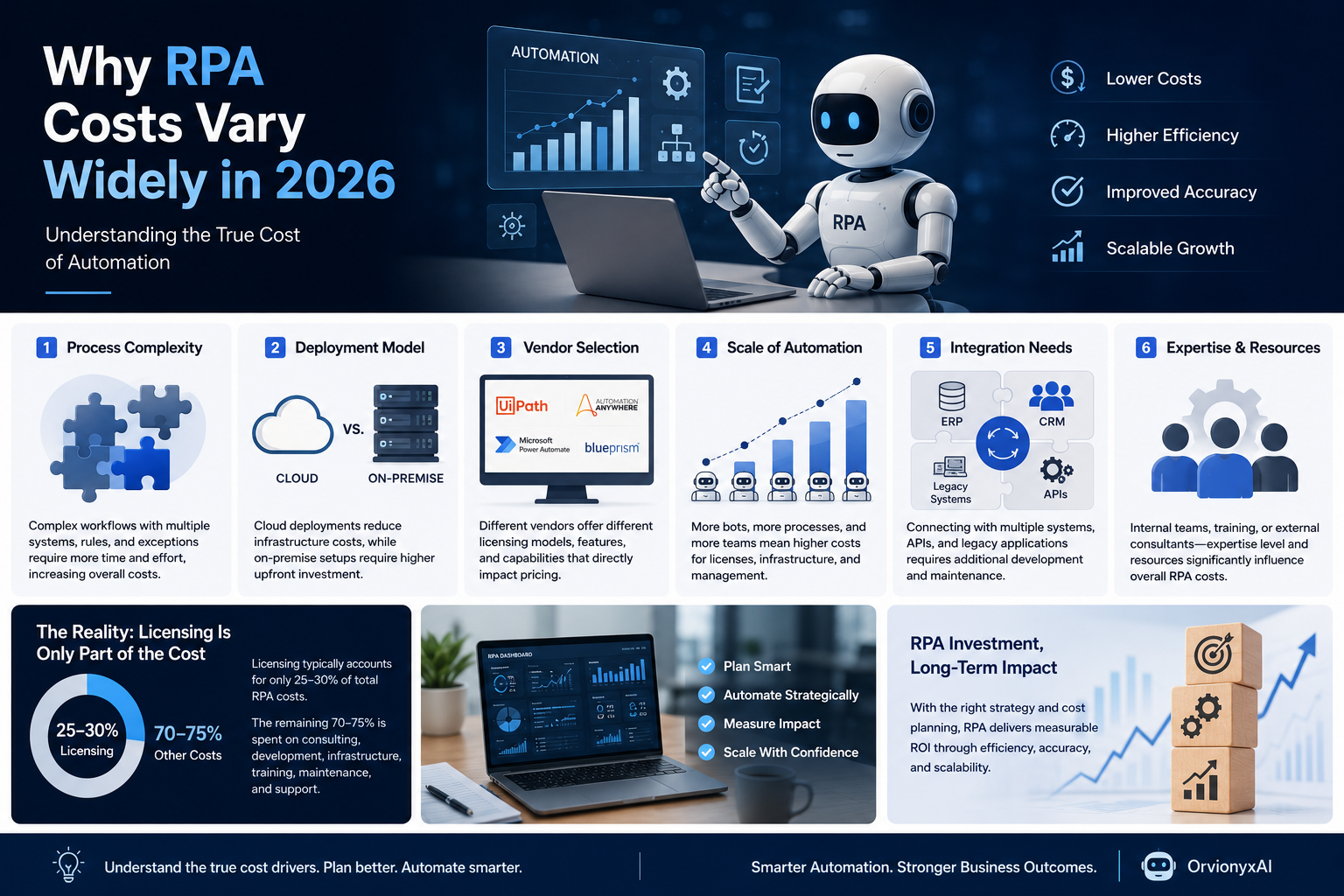
Licensing typically accounts for only 25–30% of total RPA costs.
The remaining 70–75% is often spent on:
- Consulting services
- Development
- Infrastructure
- Integration
- Testing
- Training
- Change management
- Ongoing maintenance
Organizations that budget only for software frequently underestimate the true cost of automation initiatives.
How to Maximize RPA ROI
Despite these costs, successful automation programs often generate substantial returns.
To maximize ROI:
Start Small
Begin with high-volume, repetitive processes that deliver quick wins.
Prioritize Business Value
Focus on workflows that create measurable operational impact.
Standardize Processes
Well-defined processes are easier and less expensive to automate.
Build Governance Early
Establish automation standards before scaling across the organization.
Consider AI-Powered Automation
Modern AI agents can extend RPA capabilities by handling decisions, exceptions, and unstructured data more effectively.
Final Thoughts
RPA remains one of the most powerful technologies for driving operational efficiency in 2026. However, understanding the full cost of automation is critical for success.
Process complexity, deployment models, vendor selection, integration requirements, scalability, and expertise all contribute to the final investment. Organizations that plan beyond licensing costs and consider the complete automation lifecycle are far more likely to achieve sustainable results.
The goal is not simply to automate more processes—it is to automate the right processes in the most cost-effective way possible.
When approached strategically, RPA can deliver significant productivity gains, lower operational costs, and a strong long-term return on investment.