
Quick Summary
The AI agent lifecycle spans five critical stages design, development, testing, deployment, and continuous monitoring all connected through a strong governance layer. Based on Accelirate’s 2025 enterprise implementations, most agent failures occur not during launch, but between days 30 and 90 when model drift and operational issues go unnoticed. Establishing structured lifecycle management from the start can reduce these risks by more than 60%.
AI agents have moved beyond proof-of-concept stages and are now operating in production environments handling customer interactions, processing transactions, managing schedules, and making decisions at machine speed.
However, many enterprises focus heavily on launching AI agents while overlooking long-term lifecycle management. An agent that performs effectively on day one can gradually drift, produce unreliable outcomes, or even become a compliance risk within a few months.
Without a structured framework for designing, testing, deploying, monitoring, and retiring AI agents, these risks can scale rapidly across the organization.
This is exactly why the AI agent lifecycle has become a critical operational discipline for enterprises adopting AI at scale.
What Is the AI Agent Lifecycle? (And Why It Matters for Enterprises)
The AI agent lifecycle represents the complete journey of an AI agent from identifying a business need to deployment, continuous optimization, and eventual retirement. It includes every stage of the process: ideation, design, development, testing, deployment, monitoring, governance, and maintenance.
Unlike traditional software, AI agents are non-deterministic. Conventional applications follow fixed instructions, but AI agents interpret intent, reason through tasks, choose tools dynamically, and generate context-based outputs. While this flexibility enables powerful automation, it also introduces operational, security, and compliance risks if left unmanaged.
For enterprises aiming to achieve long-term ROI from AI agents, lifecycle governance becomes essential. Organizations must continuously evaluate critical operational questions such as:
Is the agent operating within its intended scope?
Does it have only the permissions it truly needs?
Can its behavior be validated under real-world conditions?
Can teams identify model drift or performance degradation after deployment?
Are prompt, policy, and tool changes fully traceable?
Can the business confidently trust the agent’s actions in production?
Without a structured AI lifecycle governance framework, enterprises risk far more than poor user experiences. They expose themselves to compliance failures, security vulnerabilities, operational instability, and reputational damage.
What are the five stages of the AI agent lifecycle?
An effective AI Agent Lifecycle consists of five critical stages, with governance embedded across each phase to ensure reliability, accountability, and trust. Unlike traditional software development, governance in AI cannot be treated as a final approval step before deployment.
The foundation of a trustworthy AI agent is established much earlier through how its objectives are defined, how guardrails are implemented, how permissions are controlled, and how testing frameworks are designed. By the time an AI agent reaches production, these early decisions already determine how safely, accurately, and effectively it will operate.
This is why enterprises must approach AI lifecycle management as a continuous discipline rather than a one-time process. Every stage plays a direct role in ensuring that agents remain secure, compliant, scalable, and aligned with business goals over time.
Let’s explore each stage of the AI Agent Lifecycle in detail:
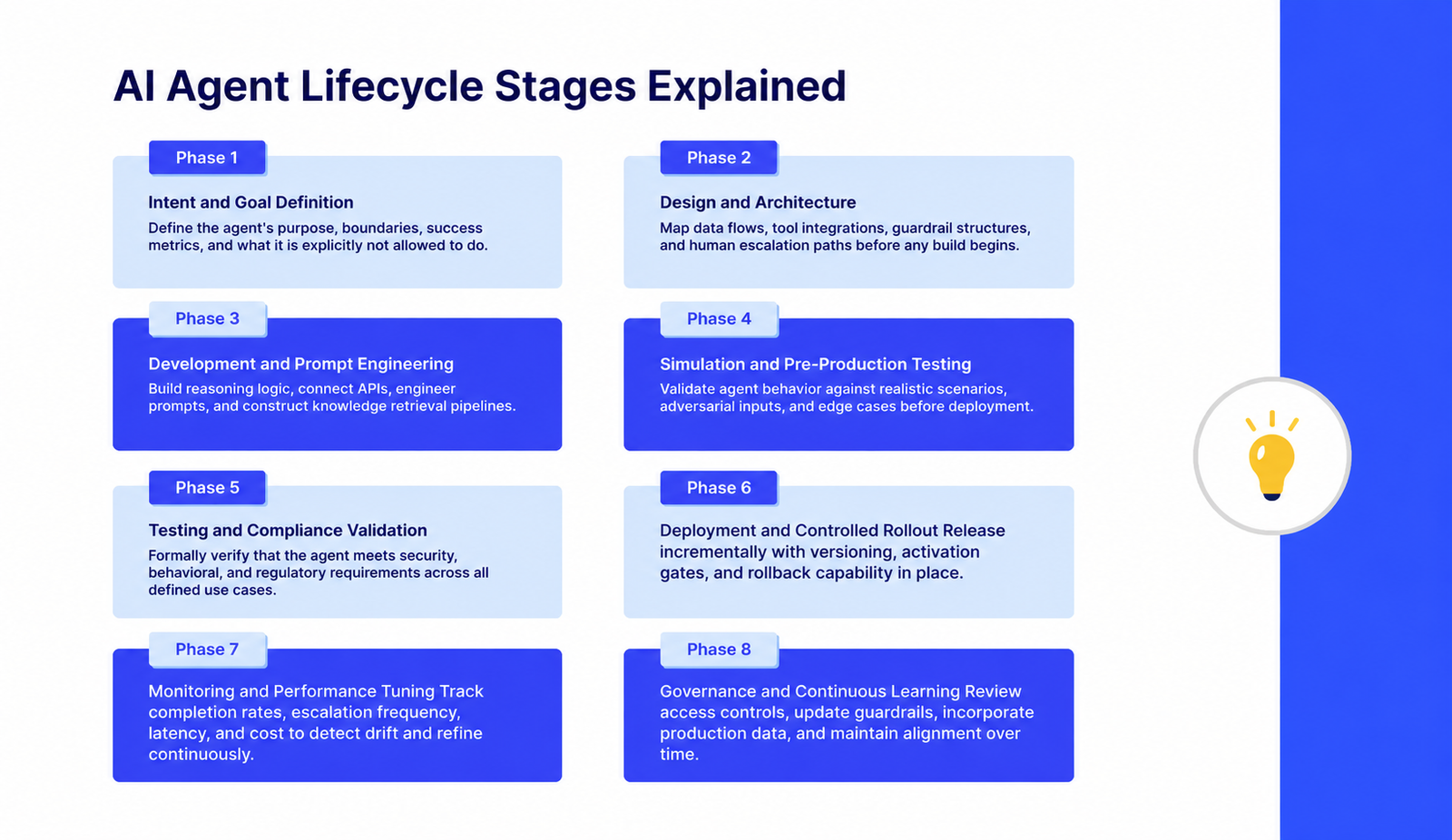
Stage 1. Ideation and Design
This initial phase focuses on defining the AI agent’s core purpose, target users, required tools, operational boundaries, and measurable success criteria. It establishes the strategic foundation, governance framework, and guardrails that guide the entire AI lifecycle. Clear intent definition at this stage ensures aligned agent behavior, efficient decision-making, and scalable performance. Poorly defined objectives or weak requirements in the beginning can lead to inaccurate outputs, operational risks, and misaligned AI behavior in later development stages.
Stage 2. Development
In the second stage, developers build the agent’s reasoning framework by connecting it to tools, APIs, and enterprise systems while engineering prompts and creating data pipelines including RAG pipelines for knowledge retrieval when required. This phase functions as the agent’s “inner loop,” where teams continuously build, test, refine, and optimize the agent’s behavior through rapid iteration. The goal is to improve decision-making accuracy, reliability, contextual understanding, and overall task performance before moving toward large-scale deployment.
Stage 3. Testing and Validation
Unlike conventional software testing, AI agent testing goes beyond verifying whether the system produces the correct output. Enterprises must ensure that the agent behaves consistently, safely, and predictably across a wide range of real-world and even hostile scenarios.
At this stage, organizations conduct unit testing, scenario-based testing, adversarial testing, and red-team exercises to evaluate how the agent responds under pressure, ambiguity, unexpected inputs, and misuse attempts. The objective is not only to validate functionality, but also to confirm that the agent remains aligned with business rules, security policies, compliance requirements, and operational guardrails in dynamic production environments.
Stage 4. Deployment and Release
AI agents must be version-controlled, deployed through managed rollout strategies, and activated independently to maintain operational stability and governance oversight. Activation itself should be treated as a governance checkpoint meaning an agent does not become operational automatically after deployment. Instead, manual activation enables final quality validation, policy verification, and controlled release management while also allowing teams to quickly roll back changes if unexpected issues arise in production.
Stage 5. Monitoring and Tuning
Monitoring and fine-tuning may appear to be the final stage of the AI agent lifecycle, but they actually begin the continuous “outer loop” of optimization and governance. AI agents must be constantly monitored for task completion rates, latency, escalation frequency, and recurring errors to ensure consistent performance. In Accelirate-managed deployments, 8 out of 10 agents without defined behavioral baselines showed measurable drift within 45 days highlighting why establishing performance benchmarks from day one is critical for long-term reliability and governance.
Ready to build AI agents that stay reliable beyond day 90?
AI Agent Lifecycle Management Explained
AI agent lifecycle management is the governance layer that connects all five stages of an AI agent’s journey into a unified, auditable system.
Without it, each stage runs in isolation. Business teams define intent, developers build, QA validates, IT deploys, and security monitors—but no single system ties these steps together. That disconnect creates gaps where visibility and trust can break down.
In this model, AI agents are treated as accountable digital entities with governance standards similar to human users, but tailored for autonomous behavior. Each agent is assigned a unique identity before deployment, operates under least-privilege access, generates immutable audit logs, and has credentials revoked immediately upon decommissioning.
Effective lifecycle management closes these gaps by maintaining continuity from design to operation. It ensures you can always answer critical questions: Is the agent behaving as intended? Has its behavior drifted over time? And if something goes wrong, what exactly changed—and when?
Secure AI Agent Lifecycle: Key Risks and How to Mitigate Them
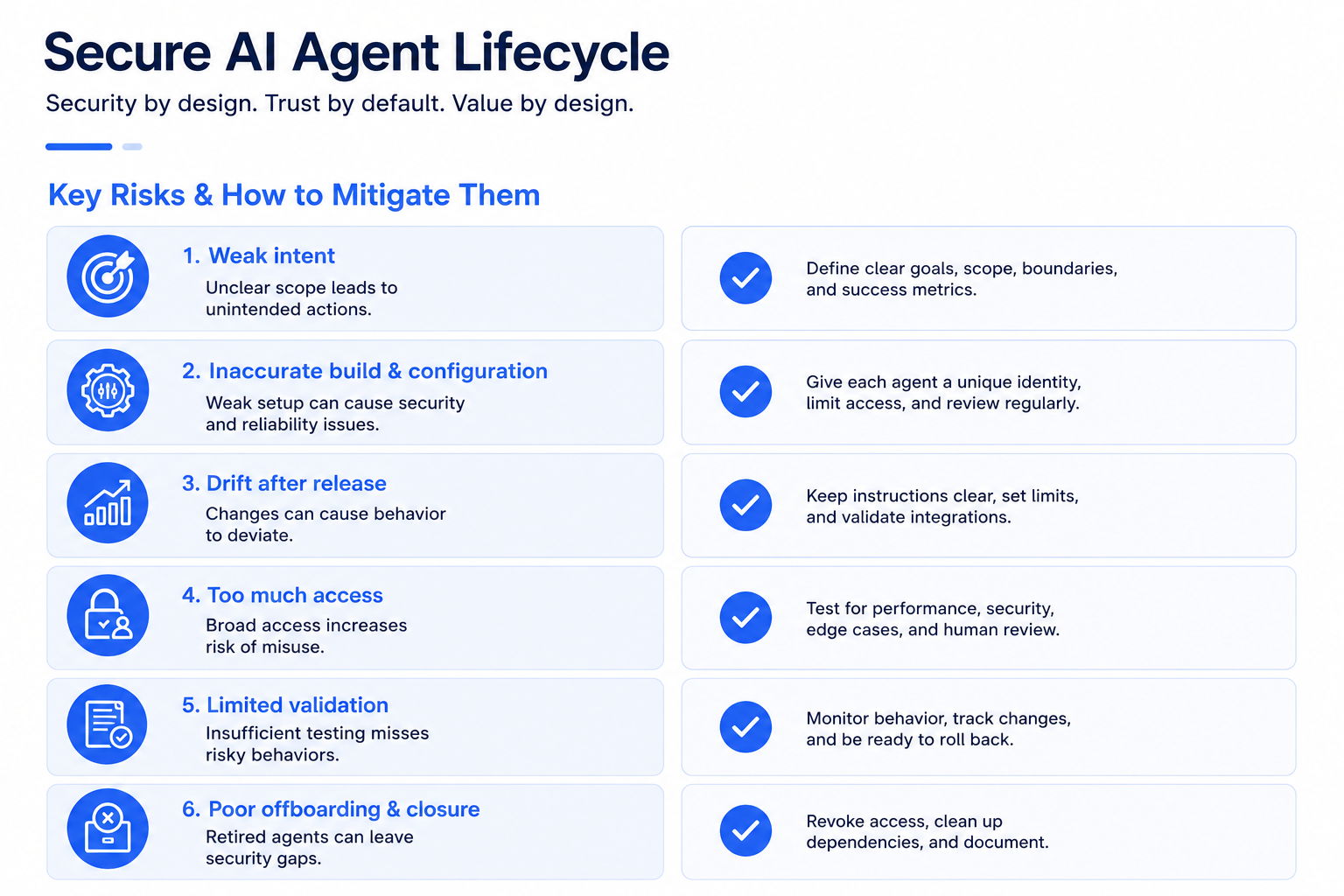
Most security conversations around AI agents happen too late after deployment, after an incident, or after an audit flags a gap. The reality is that securing the AI agent lifecycle has to start at design, not after the fact. Agents operate autonomously, connect to external tools, and access sensitive data. Here are different ways you can mitigate the risks:
1. Weak intent definition
It is essential that an AI agent’s scope is clearly defined from the outset. Without that clarity, it becomes difficult to determine whether the agent is operating correctly or safely. An agent may appear to be functioning as expected while still violating industry rules or compliance requirements in subtle ways. When purpose is vague, poorly specified, or not translated into enforceable constraints, trust in the system can quickly degrade.
To mitigate this risk, governance must begin before development starts. Each agent should be provided with clearly defined objectives, explicitly authorized actions, and strictly prohibited behaviors. In addition, escalation paths must be outlined so the agent knows when and how to defer to human oversight, along with measurable success criteria that can be used to evaluate performance objectively.
2. Too much access
Enterprise AI agents often interact with multiple systems such as internal applications, external APIs, knowledge bases, and customer data. This expands the security risk if access is overly broad, shared, or not properly tracked. Each agent should therefore have a distinct digital identity with tightly controlled, role-based permissions, granted only through approved provisioning and fully auditable activity logs.
Mitigation: Assign every agent a unique identity, enforce role-based access control, regularly review permissions, and immediately revoke credentials when an agent is retired or replaced.
3. Inaccurate build and configuration
Even with a strong initial idea, unclear prompts, weak boundaries, or poorly designed integrations can lead to serious security and reliability issues. For this reason, a safe AI agent lifecycle must include not only planning and setup, but also continuous validation while the agent is operating.
Mitigation: Keep prompts and instructions clear and concise, enforce strict limits on tool usage, continuously verify integrations, and ensure agents only perform actions that are explicitly defined and approved.
4. Limited or shallow validation
Good testing alone is not sufficient. AI agents must be evaluated against real-world variability, including edge cases, adversarial inputs, ambiguous requests, and scenarios where the correct behavior is to refuse, escalate, or strictly follow predefined rules. Uncertainty handling should be a core part of AI agent development, not an afterthought.
Mitigation: Strengthen validation by testing for performance, robustness, and safety controls. Include human review in the loop to verify behavior, ensure compliance, and confirm that the agent responds appropriately under both normal and high-risk conditions.
5. Drift after release
Once AI agents are deployed, they operate in dynamic environments where users, data, and conditions are constantly changing. This can introduce risk, especially when agent behavior begins to drift away from the original design. When that happens, trust is weakened, and it becomes difficult for teams to determine what changed, when it changed, and why.
Mitigation: Continuously monitor agent behavior in production by tracking performance, failures, and escalation events. Maintain detailed logs of changes and system interactions, and establish clear rollback mechanisms to revert to stable versions when issues arise. Ongoing observability and supervision are essential to ensure AI agents remain reliable and aligned with their intended purpose.
6. Poor offboarding and governance closure
The end of an AI agent’s lifespan is a critical part of a safe lifecycle. If retired agents still retain credentials, system access, or active dependencies, they can create unnecessary security and operational risks. Proper decommissioning—including revoking access, removing integrations, cleaning up dependencies, and updating documentation—is essential to maintain system integrity.
Mitigation: Treat retirement as a formal, controlled process rather than an informal shutdown, ensuring all access is revoked and all associated systems are properly cleaned up.
Best Practices for Secure AI Agent Lifecycle Management
A key area where AI agent discipline matters is the practices teams put in place before issues arise. Strong governance separates well-controlled deployments from reactive, error-prone systems.
Start with a clear plan for the agent, defining what it should do, how it should behave, and what it must not do. This becomes the baseline for testing, monitoring, and evaluation.
Do not rely only on “does it work” testing. An agent can run without errors but still behave incorrectly. Instead, design tests that validate both expected behavior and prohibited actions.
Testing should be continuous. Every change must trigger re-testing, as manual or one-off checks are not sufficient for maintaining reliability.
Deployment should be controlled. Introduce the agent in a staged environment first, so issues can be identified early and rolled back without disrupting production systems.
After deployment, establish a baseline of normal behavior by observing the agent over time. Understanding typical performance—such as task duration, failure rates, and escalation frequency—is essential to detecting abnormal behavior.
Finally, assign clear ownership at every stage of the lifecycle. Each agent must have someone responsible for its performance and governance, ensuring accountability is always defined and enforced.
Real-World Use Cases of AI Agent Lifecycle in Enterprises
In the early days, AI agents were mainly used for simple tasks like chat assistance or basic automation. Today, they are increasingly embedded across enterprises to support decision-making workflows, execute system actions, and manage complex, multi-step business processes.
While understanding the AI agent lifecycle conceptually is important, its real value becomes clear when applied in practice. Observing how governance, testing, deployment, and monitoring work together in real environments provides a much stronger understanding of how reliable, safe, and scalable agent systems are actually built and maintained.
Customer service agents
This is the common use in companies. An agent handles queries. Like order status, booking changes and answers to frequently asked questions. The risk here is that over time the agent starts to rely on humans often than it should which increases support costs and means something in the agent’s decision-making has changed. Keeping an eye on how the agent escalates issues to humans helps catch this problem early.
Financial and transactional agents
Agents that make purchases, process refunds or update records are more critical. Managing the AI agent lifecycle is especially important here. Each agent needs its identity, limited permissions (like autonomous approval below a certain threshold and human approval above it) and a complete record of all actions across every connected system. When these agents are decommissioned, taking away their credentials is not optional.
Internal knowledge agents
Companies use agents trained on documents. Like HR policies, compliance manuals and product specs. The challenge is keeping the agent’s knowledge up to date: when the underlying documents change the agents retrieval layer needs to be updated. The AI agent development lifecycle should include a process for updating the knowledge base when the source content changes, not just when the agents code changes.
Multi-agent orchestration
Companies are increasingly adopting multi-agent systems where agents call and depend on other agents. This introduces new risk: a behavioral change in one agent can cascade and create unintended effects downstream. Since isolated test environments cannot fully replicate real inter-agent interactions, testing individual agents in isolation is no longer sufficient.
Effective lifecycle management in these systems requires end-to-end validation across the entire chain of agents—known as multi-agent orchestration testing. This ensures that interactions, dependencies, and system-wide outcomes are evaluated together, not just at the single-agent level.
Common Challenges in AI Agent Lifecycle Management (And Solutions)
Most security conversations around AI agents happen too late after deployment, after an incident, or after an audit flags a gap. The reality is that securing the AI agent lifecycle has to start at design, not after the fact. Agents operate autonomously, connect to external tools, and access sensitive data. Here are different ways you can mitigate the risks:
1. Problem
The big problem is that teams work separately. The business team decides what they want to do. The developers build it. The QA team tests it. The IT team makes it work. The security team checks for problems. But no one team sees the picture so issues that start in one stage are not found until much later in another stage.
Solution:
To fix this we need to have a team that includes people from all stages. This team should have leaders at each stage. We need to know who is in charge of making sure everything is okay at each stage. Who says yes to the plan? Who makes sure the tests are good enough before we release it? Who watches to see if there are problems when it is live?
2. Problem
Another problem is that artificial intelligence systems do not always work the way. Traditional testing is based on systems that always work the way.. Artificial intelligence systems can give different answers to the same question. This means that just because a test works once it does not mean it will always work. This is a challenge when we are trying to make sure artificial intelligence systems are working correctly.
Solution:
To solve this problem, we need to change the way we test. If looking for the perfect answer, we should look for answers that are good enough. We should define what a good answer looks like and what a bad answer looks like. Then we should test to see if the system can give us answers. We should also test the system with questions to see if it can handle them.
3. Problem
Another challenge is that artificial intelligence systems can slowly get worse over time. This can happen because of a change in the system an update to the model or a change in how users interact with the system. These changes do not always cause problems, but they can cause problems later. By the time we notice the problem it can be hard to find the cause.
Solution:
To fix this we need to watch the system. We should track how often the system has problems, how steps it takes to complete a task and how long the answers are. These signs can tell us if the system is starting to have problems before the users notice.
4. Problem
We also have a problem with keeping intelligence systems secure. As we use more artificial intelligence systems it gets harder to manage their permissions and access. We need to make sure that each system has its identity and permissions just like a human user. We should also regularly review what each system can do and take away its permissions when it is no longer needed.
Solution:
To solve this problem, we should include intelligence systems in our existing security systems. Each system should have its identity and permissions. We should regularly review what each system can do and take away its permissions when it is no longer needed. We should also make sure to remove the systems permissions when it is decommissioned.
Another challenge is that our testing environments are not, like the world. Our test systems are. Do not have the same variety of data and usage patterns as the live systems. This means that just because a system works in testing it does not mean it will work in the world.
To fix this we should use our testing to make sure the system is probably okay but not to make sure it is perfect. We should release the system to a group of users first and watch closely to see if there are any problems. We should also have a way to roll back the system if something goes wrong. We should not be afraid to use this rollback feature if something unexpected happens.
Metrics That Define a Successful AI Agent Lifecycle
Measuring AI agent performance requires tracking two layers of metrics: operational health and behavioral quality.
- Task completion rate: The percentage of interactions where the agent successfully resolves the user’s request without human intervention. This reflects overall effectiveness.
- Escalation rate: How often the agent hands off conversations to a human. An increase may indicate performance gaps, missing knowledge, or misalignment in behavior.
- Topic classification accuracy: How reliably the agent routes requests to the correct workflow or domain. Poor routing can lead to downstream errors and inefficiencies.
- Latency per interaction: The time taken to respond or complete an action. This directly impacts user experience and should be tracked by interaction type, since some integrations are inherently slower. Sudden spikes can signal system or integration issues.
- Cost (consumption): Monitoring token or resource usage is essential for controlling operational cost. Rising consumption without increased task complexity may indicate inefficient prompts or poor retrieval behavior.
- Guardrail adherence rate: How consistently the agent operates within defined safety, security, and policy boundaries. This is critical for maintaining compliance and system safety.
- Feedback and satisfaction scores: Human evaluation remains essential for assessing qualitative aspects such as tone, clarity, and overall user experience—areas that automated metrics alone cannot fully capture.
How is AI agent lifecycle different from MLOps?
MLOps focuses on training, deploying, and monitoring machine learning models. In contrast, AI agent lifecycle management governs how autonomous agents reason, act, and interact with systems. This requires additional layers such as behavioral testing, guardrail enforcement, and identity governance—capabilities that traditional MLOps frameworks are not designed to fully address.
What is AI agent lifecycle management in simple terms?
How do you secure an AI agent lifecycle?
Which tools help with AI agent lifecycle management?
What are common failures in AI agent lifecycle and how to fix them?
The most common failures in AI agent systems include intent drift, silent production errors, and excessive or outdated access permissions that go unreviewed over time. These issues are largely preventable with disciplined governance.
Establishing clear behavioral baselines early helps detect when an agent begins to deviate from its intended purpose. Running regression tests after every change ensures that updates do not introduce unintended side effects. In addition, treating access reviews as a recurring operational process—rather than a one-time setup step—helps maintain proper security and control throughout the agent’s lifecycle.
How do enterprises manage multiple AI agents at scale?
The foundation of scalable AI agent management is standardization. Enterprises that scale effectively apply consistent lifecycle governance across all agents instead of handling each one differently. This includes unified identity management, centralized monitoring, and reusable testing frameworks that allow organizations to govern dozens of agents without a corresponding increase in operational overhead.