
Every year, financial institutions lose billions of dollars to a problem hiding in plain sight: slow, error-prone manual processing of invoices, KYC documents, compliance reports, and transaction data. The average mid-sized bank processes over 50,000 invoices per month — each one touched by human hands at least three times before payment is approved.
That era is ending.
In 2026, forward-thinking banks, insurance carriers, and financial services firms are deploying AI-powered automation to eliminate manual bottlenecks at every stage of their operations. From invoice processing automation and KYC automation software to fraud detection AI and financial compliance RPA, the transformation is no longer a pilot project — it is a competitive mandate.
This guide breaks down exactly how these technologies work, what results real enterprises are achieving, and how your organization can get started.
1. The Real Cost of Manual Financial Processing
Before we explore the solutions, let us be honest about the scale of the problem. Manual financial processing is not just slow — it is catastrophically expensive when you add up all the hidden costs:
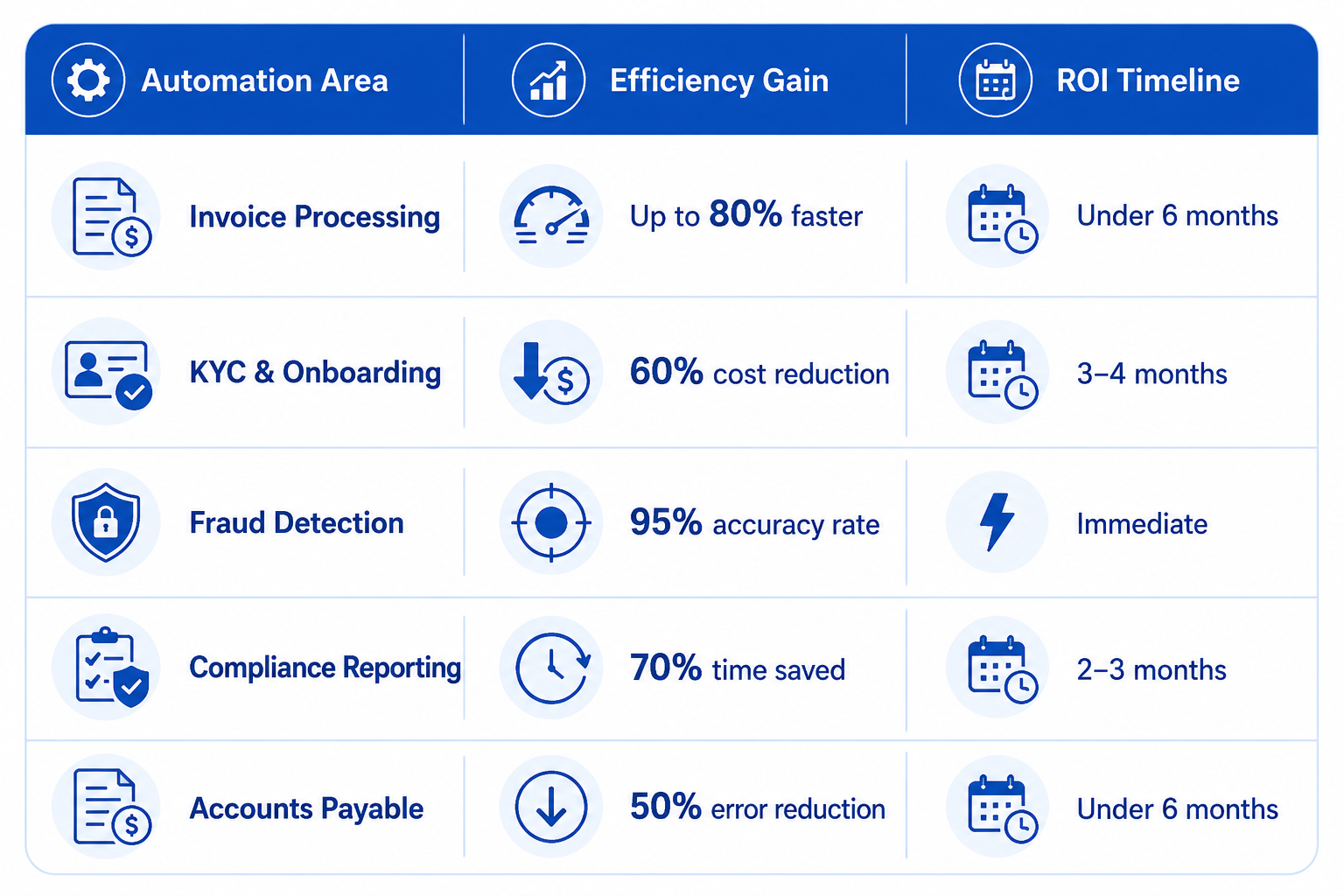
According to industry data, the global RPA market in BFSI alone was worth over $12.8 billion in 2025, and financial institutions deploying AI-powered automation report an average cost reduction of 35–60% across their back-office operations. The question is no longer whether to automate — it is how fast you can do it.
2. Invoice Processing Automation: Eliminate Your AP Backlog
What Is Invoice Processing Automation?
Invoice processing automation uses AI agents combined with robotic process automation (RPA) to capture, validate, route, and post invoices — from receipt to payment approval — without human intervention for standard cases.
A modern invoice processing automation system handles every format: PDFs, scanned paper invoices, email attachments, EDI files, and supplier portal exports. The AI reads the invoice, extracts line items, matches them against purchase orders, flags discrepancies, and routes exceptions to the right approver — all in seconds.
Key Capabilities of Modern Invoice Processing Automation
- Intelligent document capture with OCR and AI extraction (handles any template or format)
- 3-way PO matching: invoice vs. purchase order vs. goods receipt
- Automatic GL coding and cost center allocation
- Exception handling and escalation routing
- ERP posting to SAP, Oracle, NetSuite, or any target system
- Real-time dashboard with SLA tracking and audit trail
- Duplicate invoice detection using AI similarity matching
Real Results: Invoice Processing Automation in Action
A global insurance carrier processing 80,000+ invoices per month deployed OrvionyxAI’s invoice processing automation solution. Results after 90 days: processing time reduced from 8 days to 4 hours, error rate dropped from 4.2% to 0.3%, and AP team redeployed to higher-value vendor relationship management. Annual savings: $2.1 million
Invoice Processing Automation vs. Traditional OCR
Many organizations tried first-generation OCR tools and found them disappointing — rigid templates that broke whenever a supplier changed their invoice layout. Modern AI-powered invoice processing automation is fundamentally different. Instead of template matching, it uses large language models trained on millions of financial documents to understand invoice structure semantically, regardless of format. It gets smarter with every document processed.
3. Banking Automation Solutions: Rebuilding Core Operations
Banking automation solutions have evolved well beyond simple data entry bots. Today’s AI-first banking automation solutions orchestrate end-to-end processes that span multiple systems, require decision-making, and must operate under strict regulatory oversight.
Top Use Cases for Banking Automation Solutions in 2026
- Account opening and onboarding: reduce a 3-day process to under 20 minutes
- Loan origination and credit decisioning: automated document collection, scoring, and approval routing
- Reconciliation: automated matching of millions of transactions across ledgers daily
- Customer service automation: AI agents handling tier-1 queries with seamless human escalation
- Regulatory reporting: automated generation of Basel III, DFAST, and CCAR reports
- Trade settlement and confirmations: straight-through processing at scale
- Branch operations: AI-assisted teller support and back-office task automation
Why Traditional RPA Is Not Enough for Banking
First-generation banking automation solutions were built on rule-based RPA bots. They worked well for predictable, structured tasks — but banks quickly discovered their limits. Bots broke when UI screens changed. They could not handle unstructured documents. They had no capacity for judgment or exception handling.
The new generation of banking automation solutions pairs RPA execution with AI-driven decision-making. An AI agent understands the context of each transaction, reads and interprets documents, and makes or routes decisions — while RPA bots handle the system interactions. This combination delivers the reliability banks require with the intelligence that modern operations demand.
4. KYC Automation Software: Onboard Faster, Stay Compliant
Know Your Customer (KYC) is one of the most labor-intensive processes in financial services — and one of the most critical. A single KYC file can require reviewing dozens of documents, running identity checks against multiple databases, screening for sanctions and PEPs, and producing a comprehensive risk assessment report.
Manual KYC costs banks an average of $25,000 per corporate client onboarding. KYC automation software cuts that cost by up to 70% while improving accuracy and reducing onboarding time from weeks to hours.
What Modern KYC Automation Software Does
- Automated document collection via digital portals and email extraction
- AI-powered identity verification: passport, ID, and utility bill OCR with liveness detection
- Automated database screening: sanctions lists, PEP databases, adverse media, beneficial ownership registries
- Risk scoring and customer risk classification (CDD/EDD triggers)
- Ongoing monitoring with automated re-screening and alert triage
- Full audit trail and compliance documentation generation
- Integration with core banking systems, CRM, and compliance platforms
KYC Automation Software and Regulatory Compliance
A common concern we hear from compliance officers: does KYC automation software actually satisfy regulators? The answer is yes — when built correctly. Regulators do not require human review of every document; they require a documented, repeatable, auditable process. Well-designed KYC automation software provides exactly that, with complete audit trails, documented decision rationale, and configurable approval thresholds that keep humans in the loop for high-risk cases.
KYC Automation Results
A regional commercial bank running 400+ monthly corporate KYC reviews reduced average review time from 14 days to 36 hours using AI-powered KYC automation software. False positive rates from sanctions screening dropped by 62%, allowing compliance analysts to focus on genuinely complex cases. Client satisfaction scores for onboarding improved by 38 points.
5. Fraud Detection AI: Stop Losses Before They Happen
Fraud detection AI represents one of the highest-ROI applications of artificial intelligence in financial services. Traditional rule-based fraud detection systems generate enormous numbers of false positives — up to 99% of flagged transactions can be legitimate — wasting analyst time and damaging customer experience. Meanwhile, sophisticated fraud schemes evolve faster than static rules can be updated.
Modern fraud detection AI uses machine learning models trained on millions of historical transactions to identify anomalies in real time, adapting continuously as new fraud patterns emerge.
How Fraud Detection AI Works
- Real-time transaction scoring: every transaction assessed in under 50 milliseconds
- Behavioral biometrics: typing patterns, device fingerprinting, session behavior
- Network graph analysis: identifying coordinated fraud rings across accounts
- Unsupervised anomaly detection: finding new fraud types not seen in training data
- Explainable AI: every decision comes with a human-readable rationale for compliance
- Continuous model retraining as new fraud patterns emerge
Fraud Detection AI Across Financial Products
Fraud detection AI is not a single solution — it applies differently across product lines. For payments and wire transfers, real-time velocity and behavioral analysis is critical. For insurance claims, it involves document authentication and claimant history analysis. For credit applications, it involves identity and synthetic fraud detection. For trading operations, it involves market manipulation and insider trading pattern recognition.
OrvionyxAI’s fraud detection AI framework is designed to cover all of these scenarios within a single governance layer, ensuring consistent risk thresholds and audit standards across the entire fraud operations function.
6. Financial Compliance RPA: Automate the Regulatory Burden
Regulatory compliance is the fastest-growing cost in financial services. The average large bank now spends over $10,000 per employee per year on compliance-related activities. Financial compliance RPA directly addresses this by automating the most time-consuming compliance workflows.
Where Financial Compliance RPA Delivers the Most Value
- Regulatory reporting: automated generation, validation, and submission of regulatory reports (Basel III, MiFID II, Dodd-Frank, CCAR, DFAST)
- Trade surveillance: monitoring and flagging potential market abuse across thousands of daily trades
- AML transaction monitoring: automated case creation, evidence gathering, and SAR filing
- Policy attestation management: tracking employee acknowledgements and certifications
- Audit preparation: automated evidence collection and control testing documentation
- Data lineage tracking: maintaining complete records of data transformations for regulatory review
- Change management: automated impact assessment when regulations are updated
Financial Compliance RPA with Human Oversight
One principle we hold non-negotiable in every compliance automation deployment: humans remain in the lead. Financial compliance RPA handles the high-volume, structured work — collecting data, running checks, generating reports, flagging exceptions. But the judgment calls, the escalations, and the final sign-offs remain with qualified compliance professionals. This is not a limitation — it is the architecture that satisfies both regulators and your own risk management standards.
7. Building an AI-First Financial Operations Architecture
The organizations achieving the highest returns from financial automation are not deploying point solutions. They are building an integrated AI-first operations architecture where invoice processing automation, KYC automation software, fraud detection AI, and financial compliance RPA work together within a single orchestration layer.
The OrvionyxAI 5-Week Activator for Financial Services
Most financial automation initiatives fail not because the technology does not work — but because of poor implementation methodology. Discovery drags on for months. Pilots never scale. Governance is added as an afterthought.
The OrvionyxAI 5-Week Activator is a structured implementation framework developed specifically to compress the path from strategy to live autonomous operations:
- Week 1: Process discovery and prioritization — identify the highest-ROI automation opportunities using process mining
- Week 2: Architecture design — define the agentic orchestration layer, integration points, and governance controls
- Week 3: Build and configure — deploy pre-built accelerators for your specific financial use cases
- Week 4: Testing and validation — comprehensive testing against your actual data and regulatory requirements
- Week 5: Go-live — first AI agents operating in production, with full human oversight infrastructure
The result: live autonomous operations in 5 weeks, with a governance framework that satisfies your compliance team, your auditors, and your regulators.
8. Choosing the Right Automation Partner for Financial Services
Not all automation vendors are equipped for the specific demands of financial services. When evaluating banking automation solutions, KYC automation software, or financial compliance RPA providers, ask these questions:
- Do they have documented experience in regulated financial services environments?
- Can they demonstrate compliance with HIPAA, SOX, Basel III, or other relevant frameworks?
- Do they offer built-in audit trails and human approval checkpoints?
- Can they integrate with your existing core banking, ERP, or CRM systems?
- Do they provide ongoing managed services, or only initial implementation?
- What does their governance framework look like in practice?
- Can they show verifiable ROI results from comparable deployments?
OrvionyxAI was built specifically to answer yes to all of these questions. As a UiPath Diamond Partner with deep expertise in financial services automation, we combine platform capability with domain knowledge and a governance-first approach that keeps your operations compliant at every stage of growth.
Conclusion: The Window for Competitive Advantage Is Now
Invoice processing automation, banking automation solutions, KYC automation software, fraud detection AI, and financial compliance RPA are not emerging technologies anymore. They are proven, production-grade solutions delivering measurable ROI for financial institutions of every size.
The organizations that move now will compound those gains over time — building data advantages, operational efficiencies, and institutional knowledge of AI-augmented workflows that competitors who wait will struggle to replicate.
Your competitors are already running on agents. The question is whether you lead this transformation or respond to it.
Ready to Automate Your Financial Operations?
Talk to the OrvionyxAI team about a personalized automation roadmap for your organization. We offer a complimentary process assessment that identifies your top 5 automation opportunities and projects ROI based on your actual operational data. No pilots. No lengthy discovery. Live agents in 5 weeks — guaranteed. Book your Executive AI Strategy Call at orvionyxai.com