
Quick Summary
Financial AI Agents go beyond traditional RPA by reasoning through complex tasks, handling exceptions autonomously, and continuously learning from patterns across financial systems. Organizations are realizing 3–6x ROI within the first year by applying AI agents to accounts payable, fraud detection, compliance monitoring, and financial close processes. With a structured four-phase implementation approach and strong governance frameworks, finance teams can automate high-volume operations while maintaining oversight — shifting from repetitive task execution to strategic, insight-driven decision-making.
What would a finance operation look like if routine repetitive tasks, which take up a major fraction of the workforce’s productive time, could manage themselves, decisions could be made in real-time, and workflows could be adapted through automation?
This is an extensive resource guide for financial executives interested in learning about AI agents in finance. It introduces the next revolution beyond RPA and rule-based automation. With 98% of CFOs reporting investments in automation resulting in a decrease of 90% in reporting errors, the financial industry is clearly stating a transformative shift in accuracy, efficiency, and operational stability.
Why AI Agents Are a Game Changer in Financial Services
Finance leaders today are under constant pressure to accelerate financial close cycles, strengthen compliance, improve forecasting accuracy, and deliver real-time business insights, all while reducing operational costs and managing growing complexity across systems and data.
Finance has always been a data-intensive, process-driven function, making it one of the biggest beneficiaries of AI-powered automation and Agentic AI. Yet many organizations still rely on legacy automation tools built for static workflows. Traditional RPA transformed repetitive task execution, but it struggled with unstructured data, dynamic decision-making, and exception handling. It could automate steps, but it could not reason, adapt, or act autonomously.
AI Agents are redefining intelligent finance operations. Powered by generative AI, machine learning, and autonomous workflow orchestration, these agents go beyond task automation to deliver cognitive automation at scale. They can analyze financial data in real time, manage exceptions intelligently, learn from transaction patterns, coordinate across ERP and finance systems, and proactively identify risks before they become critical issues.
From autonomous reconciliations and AI-driven compliance monitoring to predictive fraud detection and intelligent accounts payable automation, AI Agents are enabling finance teams to operate faster, smarter, and with greater accuracy. For modern financial services organizations, this is more than digital transformation; it is the shift toward autonomous finance and next-generation operational intelligence.
How Finance AI Agents Differ from RPA and Traditional Automation
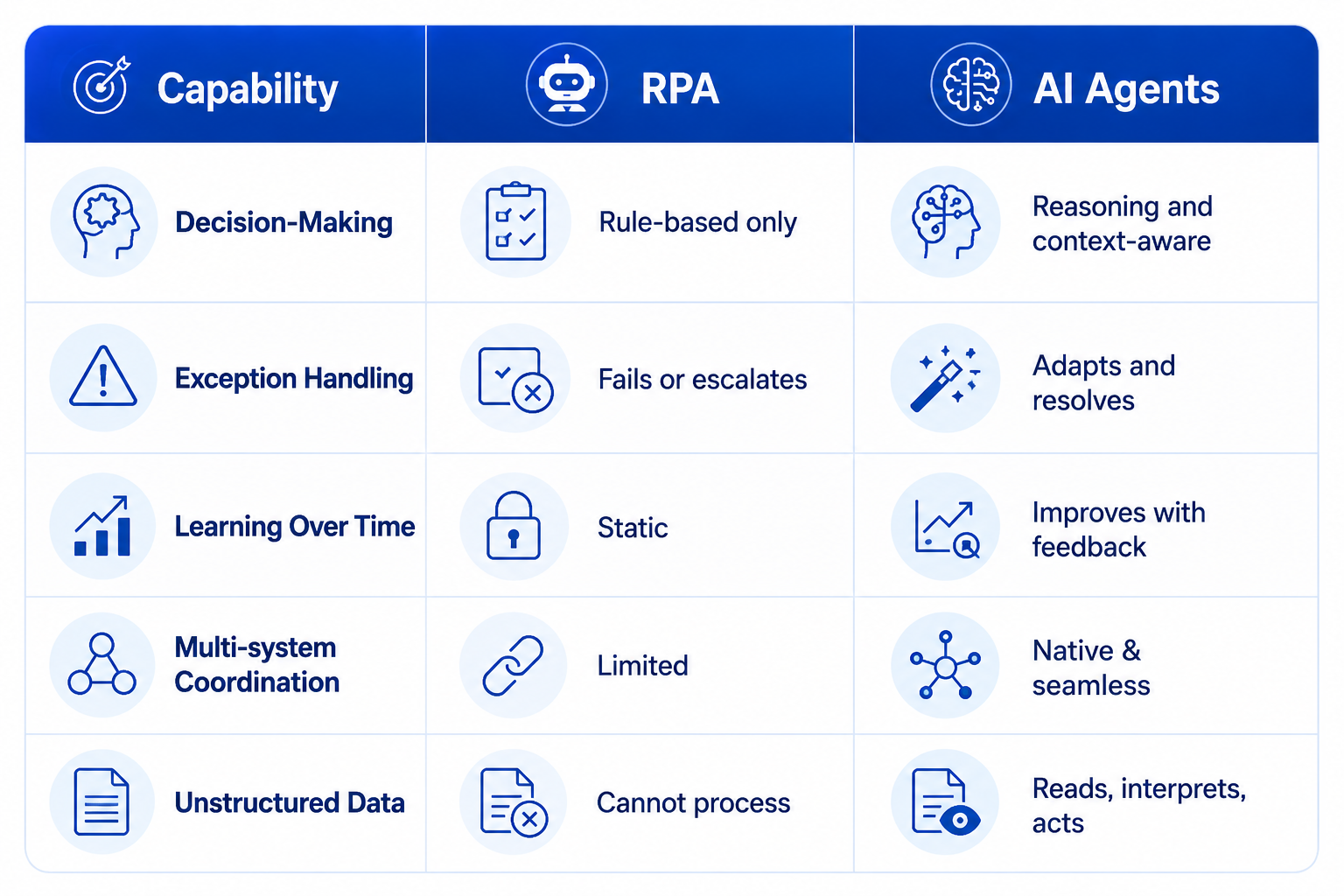
RPA follows predefined rules and structured workflows with high accuracy, but it is limited to fixed instructions and cannot adapt beyond programmed steps. AI Agents, on the other hand, are goal-driven intelligent systems that understand context, make decisions, learn from patterns, and adapt dynamically to changing business environments.
What Are AI Agents in Finance?
An AI Agent in finance is an intelligent software system that can observe its environment, make goal-driven decisions, and take autonomous actions to complete end-to-end financial workflows with minimal or no human involvement. Unlike traditional rule-based automation that depends on predefined instructions for every scenario, AI agents can operate dynamically within business policies, responding in real time to new data while understanding the context behind each decision.
For example, an AI agent can receive an invoice, validate it against a purchase order in the ERP system, identify discrepancies, draft a supplier communication, and log the exception automatically without manual intervention. This is no longer a future vision but a real capability already transforming modern finance operations.
Key Components of a Finance AI Agent
Perception Layer: Collects and interprets data from invoices, emails, ERP/CRM platforms, banking systems, and market feeds.
Reasoning Engine: Uses Large Language Models (LLMs) and AI logic to understand context, apply policies, and determine the best action.
Action Layer: Executes tasks such as updating records, generating reports, triggering workflows, or sending alerts automatically.
Memory & Learning: Stores contextual knowledge across interactions and continuously improves performance based on feedback and outcomes.
The Rise of AI Agents For Financial Services
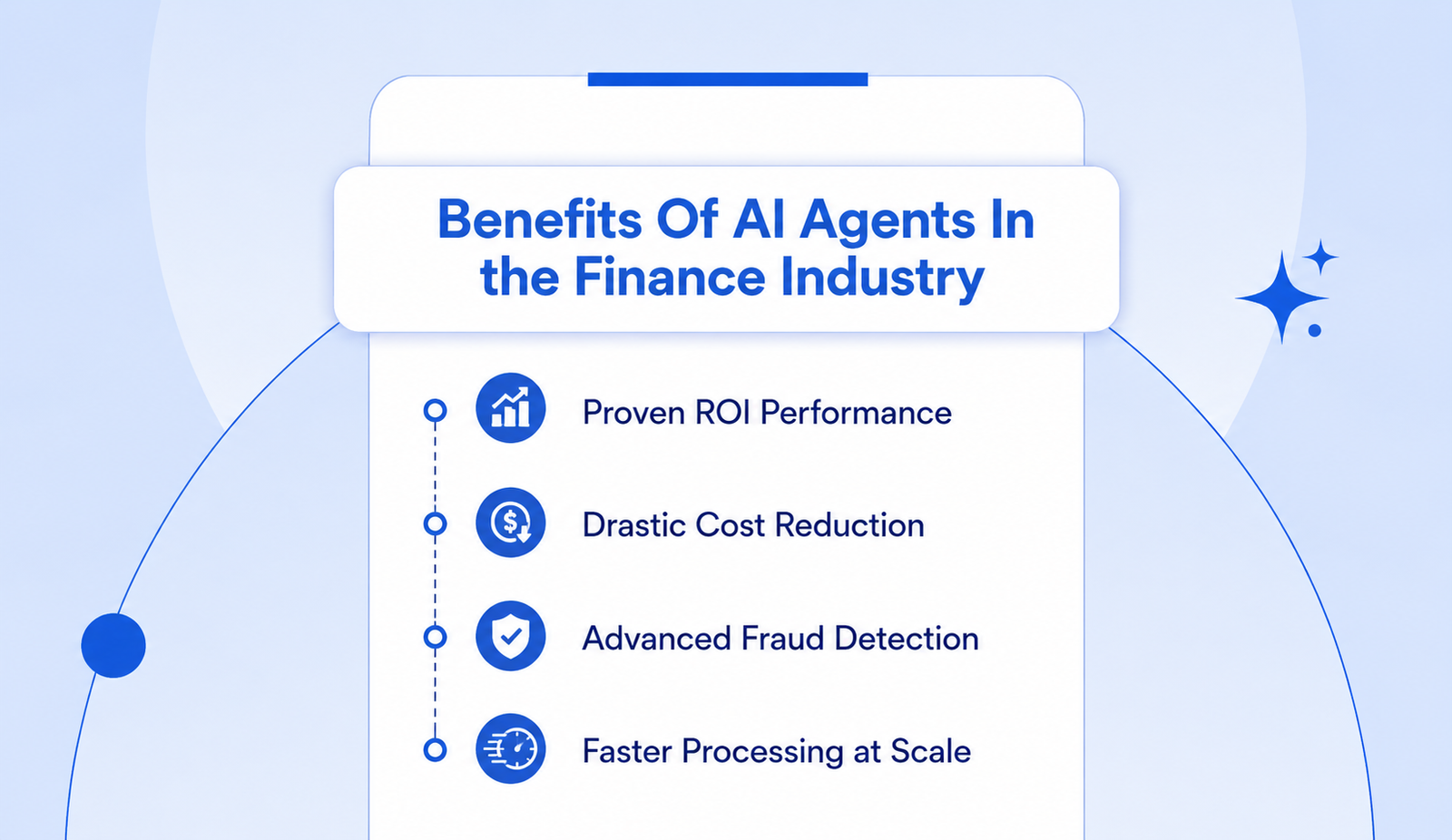
The benefits of AI Agents in finance go far beyond simple time savings. Organizations deploying AI agents at scale are seeing measurable improvements in ROI, operational efficiency, fraud prevention, and transaction processing speed.
Proven ROI Performance – Enterprises are achieving 3x to 6x ROI within the first year of implementation, with over 62% of organizations reporting returns exceeding 100% from Agentic AI initiatives. Autonomous AI agents are delivering average ROI rates of nearly 80%, outperforming traditional AI transformation programs.
Significant Cost Reduction – Financial institutions are reporting 40–60% efficiency gains across onboarding, compliance, settlements, and back-office operations. With AML and KYC operations costing companies an average of $72.9 million annually, AI agents are helping reduce operational overhead and optimize resource utilization.
Advanced Fraud Detection – AI-powered fraud detection systems are improving accuracy while dramatically reducing manual investigation workloads. Some institutions have reduced fraud losses by up to 78% while maintaining accuracy rates above 99%, enabling faster and more proactive risk management.
Faster Processing at Scale – AI agents can process thousands of transactions in minutes, far beyond human operational capacity. Banks such as ABN AMRO achieved up to an 80% reduction in KYC onboarding time using AI-driven automation, while month-end close cycles that once required five days can now be completed within a single day.
Agentic ERP Platforms
The best AI agents aren’t just technically capable because they are built for the realities of finance. Financial leaders are advised to look for solutions that offer explainability (agents that can show their reasoning), deep integration with existing ERP and data systems, strong audit trails, proven ROI within 3-6 months, and the ability to operate within regulatory limitations out of the box.
AI Agents For Financial Services Use Cases (Practical Examples)
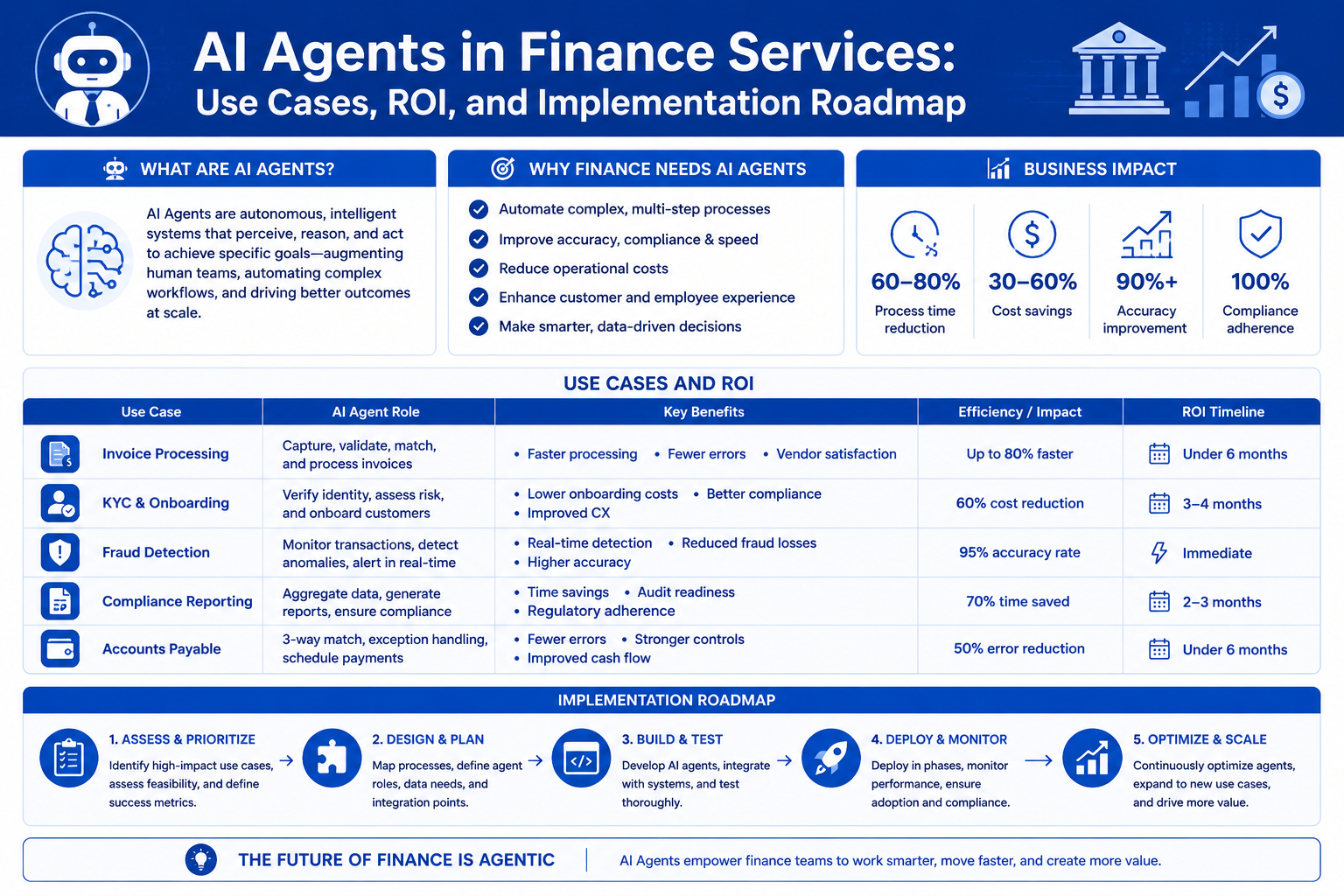
Here are the AI Agents for financial services use cases that are generating the highest impact right now, supported by real deployment data.
Accounts Payable & Receivable Automation
AI Agents in corporate finance are transforming invoice processing and financial data entry, tasks that consume a significant portion of finance teams’ daily operations. These intelligent systems can automatically capture invoice data, validate transactions, identify duplicate invoices, detect fraudulent activities, and prevent costly overpayments with minimal human intervention.
Unlike traditional automation tools, advanced AI agents are trained on billions of invoice records, enabling them to make context-aware decisions and accurately distinguish between legitimate exceptions and actual errors. This allows finance teams to improve accuracy, reduce manual workloads, strengthen compliance, and accelerate end-to-end accounts payable operations.
Fraud Detection & Risk Monitoring
Real-time transaction monitoring is one of the biggest advantages of AI agents over traditional fraud systems. AI agents analyze transaction patterns, user behaviour, and contextual data together to build a complete risk profile. Financial institutions using AI-driven fraud detection have improved accuracy by up to 80%, with AI systems capable of blocking nearly 92% of fraudulent transactions in real time, far faster than traditional systems that often detect fraud hours or days later.
Compliance, KYC & AML
Know Your Customer (KYC) and Anti-Money Laundering (AML) processes have traditionally been highly manual and resource-intensive, with financial institutions spending an average of $72.9 million annually on compliance operations. AI agents are now transforming these workflows by automating customer verification, risk analysis, document validation, and suspicious activity monitoring. As a result, the adoption of AI-driven KYC and AML solutions has rapidly increased from 42% in 2024 to 82% in 2025.
Algorithmic Trading & Portfolio Management
AI Agents drive algorithmic trading by processing large amounts of market data to discover trading opportunities. The best portfolio management tools handle trillions of dollars in assets with AI layers that detect investor distress using sentiment analysis. AI Agents automatically capture tax losses by tracking positions in multiple accounts and making trades to maximize tax efficiency.
Financial Close & Reporting
Month-end and year-end close processes involve large volumes of reconciliations, journal entries, and financial reporting. AI agents streamline these operations by automating sub-ledger reconciliations, identifying and explaining variances, generating draft financial statements, and creating board-ready summaries. This reduces financial close cycle times by 40–60%, allowing controllers and finance leaders to focus more on strategic analysis and decision-making instead of manual data preparation.
Measuring ROI of AI Agents in Finance
When looking at AI agents in corporate finance, every CFO asks, “What is the ROI?” and the data is convincing. Within the first year, companies stated that they earned 3X to 6X ROI. For every $1 spent, organizations often see $3 to $6 in measurable value but the real strength of AI agents in finance comes from their ability to compound returns over time.
How to calculate tangible and intangible ROI
Tangible ROI — Quantifiable factors
- Labor hours saved × hourly rate of displaced work
- Error reduction × average cost of a financial error (rework, penalties, audit findings)
- Cycle time reduction × value of faster cash conversion
- Fraud prevented × historical loss rates
- Compliance cost avoidance × regulatory fine benchmarks
Intangible ROI — Strategic factors
Better decision-making
Workforce optimization
Higher employee satisfaction
Improved audit readiness
Reduced reputational risk
Greater business agility
Stronger vendor trust
Scalable growth without rising costs
Industry-Specific ROI Benchmarks
Banking and financial institutions are achieving strong ROI from AI agent adoption within 8–24 months. Large banks are preventing between $1.5B and $4B in annual fraud losses, while AI-powered customer service operations are delivering up to 4.2x ROI by automating nearly 70% of incoming customer interactions. In accounts payable, AI automation reduces processing costs by 60–80% with an average ROI of 80%. Most organizations begin seeing measurable business value within just 3–6 months of deployment.
The Compounding Effect
AI agents continuously improve their performance through intelligent feedback loops and ongoing learning. Fraud detection systems, for example, can improve accuracy by 15–25% each year as they analyze more transaction data and identify evolving risk patterns. This continuous optimization significantly increases long-term ROI, where every $1 invested today can generate approximately $3.60 in Year 1, $6.50 by Year 3, and nearly $12 by Year 5. In addition, the AI infrastructure established for initial deployments reduces the cost and complexity of future AI projects by 30–50%, accelerating enterprise-wide automation adoption.
Implementation Roadmap for AI Agents in Financial Services
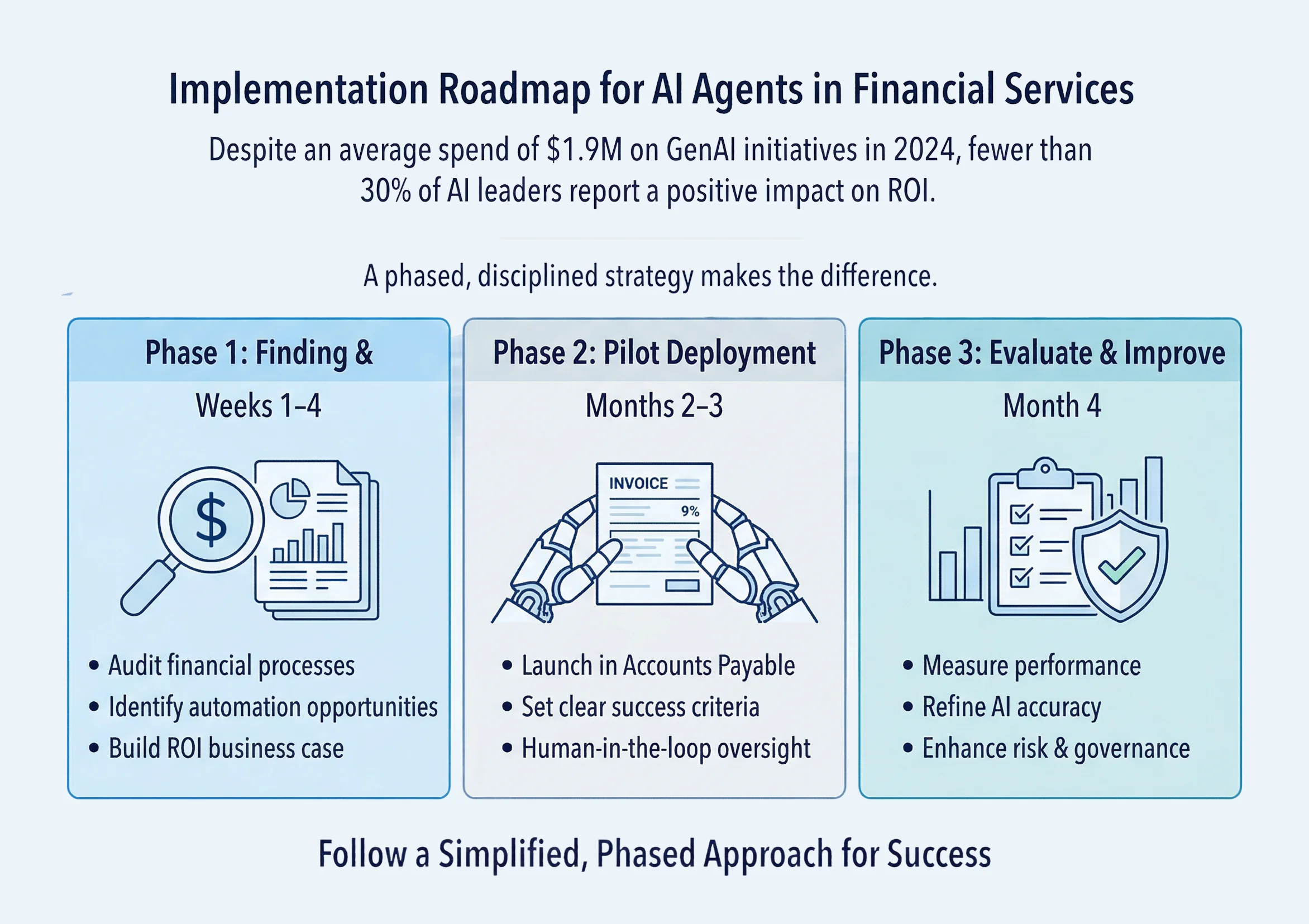
Despite an average spend of $1.9M on GenAI initiatives in 2024, fewer than 30% of AI leaders report a positive impact on ROI. The difference lies with strong returns applied with purpose and discipline. Here’s a phased approach that works:
Phase 1 – Finding And Ranking (Weeks 1–4)
Begin with a structured assessment of your existing finance processes to identify high-volume, error-prone workflows suitable for automation. Prioritize areas with the greatest operational impact, then build a clear business case with projected ROI and efficiency gains. Before implementation, ensure your existing systems, data sources, and workflows can integrate seamlessly with AI-driven solutions.
Phase 2 – Pilot Deployment (Months 2–3)
Start with a single high-impact use case, such as accounts payable automation, where organizations can achieve quick scalability, better control, and measurable outcomes. Define clear success metrics from the start and maintain human oversight for handling exceptions during the early stages. Companies that strategically adopt agentic AI systems are consistently reporting higher ROI and faster operational improvements.
Phase 3 – Evaluate And Improve (Month 4)
Measure performance against your initial goals and continuously validate that AI agent decisions remain accurate, compliant, and aligned with business policies. Maintain closed feedback loops to improve performance over time, and integrate AI directly into core financial workflows. Successful organizations manage AI agents with the same level of governance, accountability, and accuracy standards applied to human teams, while also maintaining strong risk management and audit documentation practices.
Phase 4 – Scale And Grow (Months 5–12)
Executives who embed agentic AI into daily operations—such as accounts payable—consistently achieve stronger outcomes than those who use it only for experimentation. Ongoing use deepens understanding of the business and improves decision-making over time.
Expanding into new business areas and use cases helps uncover additional value, while regular training strengthens organizational insight and adoption.
It’s also important to continuously monitor model and policy changes, and to include AI agent performance metrics in standard business reporting to ensure transparency, control, and continuous improvement.
Security, Compliance & Risk Considerations
In financial services, regulatory pressure and rising deepfake-driven fraud make security and compliance essential, not optional. AI agent deployment must be designed with governance at its core.
Regulatory alignment is critical: frameworks like the EU AI Act classify AML/KYC systems as high-risk and require transparency, while U.S. regulators such as the OCC and FinCEN emphasize explainability and auditability. Across APAC, Responsible AI guidelines further reinforce compliance expectations. AI agents must therefore be adapted to regional regulatory standards.
Data governance and privacy must be tightly controlled. Under regulations like GDPR, organizations need clear rules on what data agents can access, where it is stored, and who can view logs. Least-privilege access should be enforced, balancing transparency with strong customer data protection.
Explainability and auditability are now mandatory expectations. Every agent action should be logged with a clear decision trail to ensure full traceability. Regulators increasingly expect organizations to demonstrate how AI decisions are made, and many institutions underestimate the complexity of preparing data systems for this level of transparency.
Human oversight and accountability remain essential. High-impact decisions should include human checkpoints, ensuring final responsibility stays with people. Human-in-the-loop design preserves judgment, control, and regulatory accountability in AI-driven workflows.
6. Poor offboarding and governance closure
The end of an AI agent’s lifespan is a critical part of a safe lifecycle. If retired agents still retain credentials, system access, or active dependencies, they can create unnecessary security and operational risks. Proper decommissioning—including revoking access, removing integrations, cleaning up dependencies, and updating documentation—is essential to maintain system integrity.
Mitigation: Treat retirement as a formal, controlled process rather than an informal shutdown, ensuring all access is revoked and all associated systems are properly cleaned up.
Future of AI Agents in Financial Services
By 2029, agentic AI is expected to autonomously handle up to 80% of routine customer service inquiries, potentially driving operational cost reductions of around 30%. Over the next few years, the major shift will be toward multi-agent orchestration systems—networks of specialized agents working together across end-to-end finance workflows.
In this model, different agents handle distinct roles: an FP&A agent generates insights and forecasts, a reporting agent distributes outputs, a compliance agent evaluates regulatory implications, and an Accounts Payable agent executes transactions. These systems operate in real time, continuously exchanging information across the finance function.
Looking further ahead, AI agents in highly regulated industries may be designed to incorporate live regulatory updates, allowing them to automatically adjust workflows and decision logic as rules change—creating continuously adaptive, compliance-aware financial systems.
Choosing the Right AI Agents for Your Financial Services
For most finance leaders, the real question is not whether to adopt AI agents, but where to begin and how to implement them effectively. The evidence is already clear—organizations are using these systems daily across accounts payable, compliance monitoring, financial close, and fraud detection.
The key difference between early success and later struggle is not access to technology. The tools are widely available. What matters is starting with the right use case: one that has high transaction volume, measurable outcomes, and controlled risk. Just as important is establishing strong governance from the outset, and recognizing that this is not simply an IT initiative, but a fundamental transformation of the finance function.
Finance has always been built on accuracy, speed, and trust—areas where agentic automation delivers meaningful value. Solutions such as invoice processing automation, treasury cash flow forecasting, and regulatory compliance reporting agents are already helping teams streamline workflows while maintaining transparency and control.
Organizations that begin adopting AI agents early and build institutional knowledge over time will be better positioned to develop a lasting competitive advantage in financial markets.
Will the agent generate compliant financial reports for auditors?
Yes, AI agents can generate audit-ready financial reports with full data lineage, showing all sources and decision paths. However, compliance depends on how well the agents are configured for the specific regulatory environment, and human-in-the-loop oversight remains essential.
How do AI agents work in corporate finance?
What is the ROI of AI agents in accounts payable?
What real use cases exist for AI in banking and finance?
Key use cases span the entire finance function, including loan origination, KYC/AML compliance, fraud detection, accounts payable and receivable automation, financial close acceleration, FP&A forecasting, algorithmic trading, and customer onboarding.
Can AI agents help with compliance and audits?
Yes, AI agents continuously monitor transactions for regulatory compliance, maintain detailed audit trails, and generate documentation for faster examiner review than manual processes. They also detect regulatory changes and prompt updates to internal workflows and controls.